Every Boston renter eventually runs the same calculation. Is a one-bedroom worth the jump from a studio? Does a two-bedroom with a roommate actually beat living alone? Most people guess, and most people guess wrong, because the answer changes substantially depending on which part of Greater Boston you are looking at.
Boston Renter Intelligence Survey
How does your rent compare?
Add your numbers and get an instant read on what share of your income goes to rent, measured against what Boston renters actually report. You will also get the Q3 report free on October 7.
See how your rent compares →🏠 Top Picks for Boston Landlords & Homeowners
Shop our top-rated home essentials — smart locks, thermostats, security cameras, and more.
According to Homzora’s Q2 2026 rent data, the cost of each additional bedroom ranges from $350 to $1,300 a month depending on the area. And in all nine Boston areas where we publish both figures, splitting a two-bedroom is cheaper per person than renting a studio alone, by between $225 and $500 a month.
This article breaks down what each bedroom actually costs by neighborhood, where the roommate math is most favorable, and when living alone is worth paying for anyway. All figures come from our published Q2 2026 dataset, free to download at the end.
What the first bedroom costs
The step from studio to one-bedroom is the smaller of the two jumps in most of Boston, but the range is wide. Using the midpoint of each published range:
- Downtown Boston and Seaport District: $1,000 more per month
- Back Bay and Beacon Hill: $850
- South End: $700
- Charlestown and Somerville-adjacent: $550
- Allston, Brighton and Mission Hill: $500
- Roxbury: $400
- Roslindale and West Roxbury: $400
- Jamaica Plain: $350
The pattern is clear. In the most expensive parts of Boston, a separate bedroom is a premium product priced accordingly. Downtown charges $1,000 a month for a door between your bed and your couch. In Jamaica Plain the same upgrade costs $350.
Annualized, that Downtown difference is $12,000. The Jamaica Plain difference is $4,200. Same upgrade, wildly different price, and it is entirely a function of where you are standing.
What the second bedroom costs
The step from one-bedroom to two-bedroom is larger almost everywhere:
- Back Bay and Beacon Hill: $1,300 more per month
- South End: $1,000
- Downtown Boston and Seaport District: $800
- Charlestown and Somerville-adjacent: $800
- Jamaica Plain: $700
- Roxbury: $650
- Allston, Brighton and Mission Hill: $650
- Roslindale and West Roxbury: $600
Back Bay and Beacon Hill is the notable outlier. The second bedroom there costs $1,300, more than the first bedroom did at $850. That inversion reflects the housing stock: the neighborhood’s brownstone conversions produce far more studios and one-bedrooms than genuine two-bedrooms, and scarcity prices accordingly.
Downtown and the Seaport show the opposite pattern. The first bedroom costs $1,000, the second only $800. New construction there was built with two-bedroom floorplans in mind, so the supply is there.
The roommate math, by neighborhood
Here is the comparison most renters actually want. If two people split a two-bedroom, what does each pay, and how does that compare to each renting a studio alone?
In every Boston area we track, splitting wins. The per-person saving:
- Downtown Boston and Seaport District: studio $2,800 versus $2,300 per person. Saves $500 a month.
- Charlestown and Somerville-adjacent: studio $2,250 versus $1,800. Saves $450.
- Jamaica Plain: studio $1,850 versus $1,450. Saves $400.
- East Boston: studio $1,900 versus $1,550. Saves $350.
- Allston, Brighton and Mission Hill: studio $1,800 versus $1,475. Saves $325.
- South End: studio $2,300 versus $2,000. Saves $300.
- Roxbury: studio $1,650 versus $1,350. Saves $300.
- Roslindale and West Roxbury: studio $1,500 versus $1,250. Saves $250.
- Back Bay and Beacon Hill: studio $2,600 versus $2,375. Saves $225.
Two things stand out. First, the saving is universal, which is not obvious in advance. Second, it is largest in the most expensive areas. Downtown and the Seaport deliver $500 a month per person, $6,000 a year each. Back Bay delivers the least at $225, because that neighborhood’s expensive second bedroom eats most of the advantage.
If your priority is living in an expensive part of Boston on a normal income, a roommate is the single most effective lever available, and the data says it works best precisely where rent is highest.
When living alone is worth paying for
The math above is only the money. It is not the whole decision, and a housing research platform that pretends otherwise is not being useful.
A roommate arrangement introduces real costs that do not appear in a rent table. Joint liability on a lease means you can be responsible for the full rent if your roommate leaves. Conflict over guests, noise, cleaning, and bills is common and genuinely stressful. If you work from home, the value of a door you control is not small.
The financial saving in Roslindale and West Roxbury is $250 a month. Whether that is worth sharing a kitchen is a question only you can answer, and the honest answer for many people is no. In Downtown at $500 a month, the calculation shifts.
If you do share, put the arrangement in writing. A clear written roommate or lease agreement covering rent shares, utilities, guests, and what happens if one person leaves early prevents most of the disputes that make shared housing miserable. Massachusetts law treats co-tenants on a lease as jointly and severally liable, meaning the landlord can pursue either of you for the full amount, so the agreement between roommates is what protects you from each other.
Why the second bedroom costs more than the first in some areas
The Back Bay and Beacon Hill inversion is worth dwelling on, because it illustrates something true across Boston’s older housing stock.
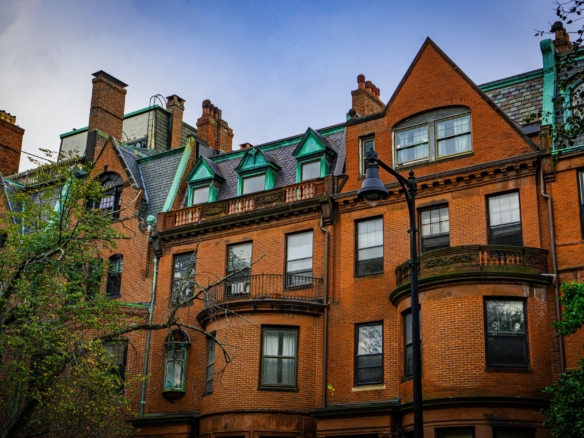
Bedroom pricing is not linear and it is not driven by square footage alone. It is driven by what the building was originally, and what it has been converted into since. Back Bay and Beacon Hill are dominated by nineteenth century brownstones that were subdivided over decades into small units. Subdivision produces studios and one-bedrooms easily. It produces genuine two-bedrooms rarely, because the floorplates do not accommodate them without sacrificing the units on either side.
Are You a Licensed MA Real Estate Agent?
List your Boston rentals and properties free on Homzora. Zero fees. Zero commissions. Direct leads sent to you.
The result is a supply imbalance. Two-bedroom seekers in Back Bay compete for a much smaller pool than one-bedroom seekers do, and the price reflects that scarcity rather than any additional value in the space itself.
Downtown and the Seaport show the mirror image. That housing stock is largely purpose-built within the last two decades, designed around two-bedroom floorplans because developers were targeting roommates and young families. Supply is adequate, so the second bedroom is priced closer to its actual marginal cost.
The practical lesson: if you are searching for a two-bedroom, the neighborhoods with older subdivided stock will punish you disproportionately, and the neighborhoods with newer construction will not. That is the opposite of the usual assumption that new construction is always the expensive option.
What to check before you sign a shared lease
The roommate saving is real, but the arrangement carries obligations worth understanding before you commit.
In Massachusetts, co-tenants on a single lease are jointly and severally liable. If your roommate stops paying, the landlord can pursue you for the entire rent, not just your half. That exposure does not end because you had an agreement between yourselves. It is worth being clear-eyed about who you sign with.
Your credit is also linked in practice if not on paper. A judgment for unpaid rent attaches to whoever is named on the lease, and a housing court record follows you into future applications. If you are entering a shared lease, checking your own credit file first is worth the time, both so you know where you stand in the application and so you can catch errors before a landlord does. SmartCredit is one way to monitor your report before you apply.
A few things to settle in writing before move-in: how rent and utilities are split and who pays the landlord directly, what happens if one person leaves before the lease ends, how the security deposit is divided at the end, guest policy, and how shared costs like internet or cleaning supplies are handled. Most roommate disputes trace back to one of those five being assumed rather than agreed.
If you are renting rather than buying, understanding your rights as a tenant matters just as much as the arithmetic. Massachusetts has meaningful protections around security deposits, habitability, and notice requirements, and they apply equally to shared tenancies.
What this data does not tell you
These figures are midpoints of Q2 2026 published ranges, and those ranges are baseline estimates derived from public listing and municipal data rather than survey responses. A midpoint is a useful summary and a poor substitute for a distribution. The real spread within each area is wide, and we cover that in detail in our companion analysis of rent spread by building.
East Boston appears in the roommate comparison but not the bedroom step-up figures, because we did not publish a one-bedroom range for East Boston in the current research cycle. We would rather leave a gap than fill it with a guess.
Our first survey-derived release publishes October 7, 2026. Actual renters reporting actual rents will let us replace midpoints with distributions, which is a genuinely better product. If you rent in Greater Boston, our renter survey takes about four minutes. Full methodology is at our methodology page.
Download the dataset
The full bedroom step-up dataset is free in CSV and JSON, licensed CC BY 4.0. No email, no paywall.
Each row includes the area, studio, one-bedroom and two-bedroom midpoints, both step-up costs, the per-person cost of a split two-bedroom, and the saving versus a studio. More datasets are at our open data hub.
The practical takeaway
If you are deciding between a studio and a one-bedroom, the premium you pay depends enormously on where you look. It is $350 in Jamaica Plain and $1,000 Downtown for the same upgrade.
If you are deciding whether to find a roommate, the money says yes everywhere in Boston, and says it loudest in the expensive neighborhoods where you might assume splitting matters least. Downtown, Charlestown, and Jamaica Plain deliver the largest per-person savings.
And if you are running affordability numbers before you sign anything, our Boston rent affordability calculator will tell you what these figures mean against your actual income.
📋 Free: The Boston Renter’s Move-In Rights Checklist
What landlords can legally charge, the 2025 broker-fee rule, and your deposit rights — one printable page.
Download the checklist (PDF) → — and subscribe for the quarterly Boston Renter Report: